
Let’s start by addressing two prevailing business myths: Employee loyalty isn’t as “dead” as many sources like to claim. The idea that “people don’t quit jobs, they quit bad managers,” is equally false. But these phrases are punchy, catchy, and easy to back up with a personal anecdote (sometimes known as “me-search”) or a couple keystrokes in a search engine.
That said, it also isn’t fair to dismiss the truths and feelings around those claims. After all, they wouldn’t have gained such popularity if they didn’t resonate with people!
We’re recruiters, and we see firsthand that people have many different reasons for changing roles. Yes, some people are escaping a bad manager. But others are perfectly happy…except for that “one little thing.” And if another company can solve that “one little thing,” some employees may consider making a change.
The basic idea here is that loyalty goes both ways. Here are a few critical ways your company can develop a workplace where employees want to stay.
Keeping Up with Compensation
You’ve probably seen the numbers, but replacing an employee can cost 50% to 200% of the previous employee’s annual salary, according to research by SHRM (check out their turnover cost calculator here). So, let’s do a little math. If you have a high-performing employee who makes $80,000 annually asking for a 5% raise, bringing their salary up to $84,000. If their request is denied and they decide to leave, it could cost up to $160,000 to replace them.
It may seem like a steep jump, but several factors drive that number.
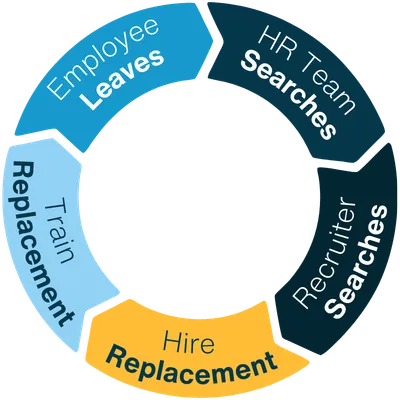
There’s the new employee’s salary, yes. But there’s also a cost to the time HR spends finding that replacement rather than making more strategic hires. How many HR team members worked on the search, and how much time did they spend? If they can’t find the right person and you bring a recruiting expert in, that expertise comes with a fee (we’re biased, but we think it’s worth it!).
Those are more easily measurable things. But beyond that, every day, hour, minute, second a role is empty is a productivity loss for your business. Even after hiring a replacement, there’s still plenty of downtime before the new team member is up-to-speed and operating at full capacity. And even then, depending on the previous employee’s tenure, you’re losing historical and institutional knowledge that’s impossible to learn without time.
So, someone making $80,000 asks for a 5% raise. They’ve established how much they feel they’re worth. If they feel their value is unrecognized, they’re more likely to seek out another company who does. And if you’re willing to offer them higher compensation in a counteroffer, ask yourself: What kept you from compensating them that way before? Being proactive in adjusting compensation could save you money in the long run versus being blindsided with turnover.
Employee Engagement Starts at the Top
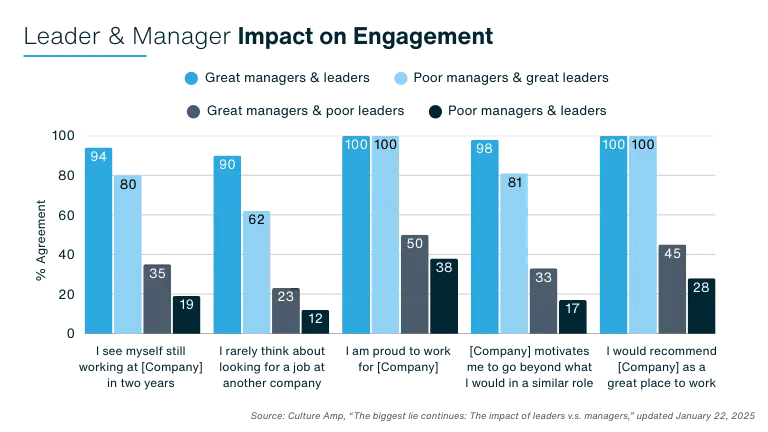
In 2024, Culture Amp looked at global data from 3+ million employees across 4700+ companies and unearthed some fascinating insights. One of the most intriguing was this: when asked about aspects of their company engagement, employees with great managers but poor leaders responded most similarly to employees with poor managers and poor leaders.
Let’s shift perspective. The engagement of employees with poor managers but great leaders was consistently twice as high (or higher!) than that of employees with great managers but poor leaders. Remember that adage about how “people don’t quit jobs, they quit bad managers?” It might be fairer to swap out “manager” for “organizational leader.”
Your managers can’t out-lead ineffective leadership higher in your company.
This raises another question. What are companies doing to develop and maintain great leaders? As it turns out, not much. Despite the vast majority of next-generation leaders saying they had a major impact on their development, less than half receive executive coaching, and barely a quarter have a mentor outside their organization.
A great way to measure this is through employee surveys that use both qualitative (written responses) and quantitative (numbers-based) data. Anonymity is key here, and using a third-party organization can help encourage more honest answers from your team.
Promote Along Desired Growth-paths

Your employees need to see a future for themselves in your company. While part of that involves feeling secure that their role won’t suddenly be eliminated, another key aspect is seeing potential for growth. If all they see five years down the line is more of the exact same work they’re already doing, they might start looking for a way out.
“Growth” can look different from one person to the next. Not everyone aspires to be CEO one day! That means helping employees figure out what “growth” looks like for them. For example, while some are interested in leading and managing people, many aren’t. And of those who are interested, not everyone is well suited for it.
From an operational perspective, this can look like open, honest, and sometimes difficult conversations setting reasonable expectations for future growth opportunities. There are many assessments available to help support and guide these discussions including:
- Wonderlic Assessment (gaps between individual skills and role expectations)
- DiSC Assessments (how people naturally engage with others)
- Gallup’s CliftonStrengths (stack-ranking inherent strengths and weaknesses)
- Kolbe Assessments (how much energy people naturally have for different types of tasks)
- Many, many more.
Connect Them to the Company’s Success
We know keeping stakeholders happy is important. But the whole reason companies seek loyalty from their employees is that without their team there are no profits (or, at the very least, they’re limited). No company can be successful without turning a profit, and employees who feel disconnected from their company’s success are unlikely to feel loyal to it. This leads to lower productivity, higher turnover, and—you guessed it—lower profits.
While part of this includes making reasonable compensation adjustments (as already discussed), the options hardly end there. Some companies offer profit-sharing, regular quarterly or annual bonuses, even extra company-wide paid days off for hitting company-wide key performance metrics (not to toot our own horn, but we do all three).
It’s probably fair to say that when people invest their time into something, they’d prefer to get something in return. Going the extra to show employees you see and appreciate how their hard work contributes to the company’s success can go a long way in employees feeling more emotionally invested long-term.
The Ball is in Your Court
In a dynamic market where things seem to change more often than they stay the same, companies can only control so much. As an employer, you have the power to make or break the employee experience. yet while you pay their salaries and offer them other benefits, most employees won’t feel that they “owe” you their loyalty. How you choose to encourage longer tenures is entirely up to you.
While employing good managers is important, it’s even more critical to ensure you have the right leaders at the top of your organization. Beyond choosing the right people from the get-go, this means continuing to offer resources to further develop healthy leadership skills.
It’s also crucial to acknowledge and show appreciation for your team members (and, no, a pizza party still doesn’t cut it). Paying your team members fairly without trying to undercut the value they bring to save a buck. Proactively and consistently rewarding good work and company achievements. Sharing success across the entire organization.
All these things play a role in creating a working environment people want to be part of. And the more you find ways to meaningfully impact your employees, the more likely they are to stay.